


What Is the Atomic Trail of Tennessee?
The Atomic Trail of Tennessee is a remote and highly technical off-road sand mine system in East Tennessee. It is associated with historic silica mining that supported industrial operations tied to the Manhattan Project era. For those seeking adventure, the Atomic Trail of Tennessee is explored in a MadLad Adventure on MadLadTV. Watch this adventure here: https://www.youtube.com/watch?v=S0Nt_szWEAY
Some trails test your vehicle.
Others test your judgment.
The sand mines of Tennessee do both.
What begins as an exploratory overlanding route quickly reveals itself as the hardest trail MadLadTV has ever attempted completely on its own. Beneath steep rock faces, exposed ledges, deep mud, and carved sandstone lies a forgotten industrial landscape. This landscape quietly fed materials into one of the most secretive chapters in American history.
Where Is the Atomic Trail Located?
The Atomic Trail exists within a remote network of historic sand mines in East Tennessee. It spreads across steep, undeveloped mountain terrain but lacks a single official trailhead or marked route.
For geographic reference, the area is accessed near the Royal Blue OHV / North Cumberland Wildlife Management Area. This is a well-known off-road recreation region in Tennessee.
Reference Access Area (Regional):
📍 Royal Blue OHV / North Cumberland Wildlife Management Area
4984 Royal Blue Rd, Pioneer, TN 37847
This address serves only as a general access reference. It is not the precise location of the historic mine structures featured in the film.
The Atomic Trail’s Role in the Manhattan Project
As the crew climbs higher into the mountains, they begin to discover old structures, cables, and pulley systems embedded in the landscape. This was evidence of a time when raw material was moved up and down these hillsides long before recreational vehicles existed.
During World War II, the United States government required enormous quantities of specialized raw materials to support the Manhattan Project, the top-secret program responsible for developing the atomic bomb. According to the U.S. Department of Energy, the Manhattan Project relied on vast industrial supply chains. These spread across the country to fuel uranium enrichment and weapons production. Learn more from the U.S. Department of Energy.
One of the most critical sites in that effort was Oak Ridge, Tennessee, where uranium enrichment facilities used experimental gaseous diffusion systems. These systems required highly specialized materials and unprecedented amounts of electricity. At its peak, Oak Ridge consumed more power than many major American cities. Check here: Oak Ridge National Laboratory – History of Oak Ridge.
High-purity silica sand, like that found in parts of Tennessee, was a key industrial material used in the manufacturing of components that supported these enrichment systems. While much of the documentation surrounding specific mine sources remains fragmented or restricted, regional history and surviving infrastructure suggest that silica sourced from Tennessee sand mines played a hidden but essential role in early atomic-era production.
The atomic bomb didn’t begin only in laboratories.
It began with resources quietly pulled from the earth.
Editor’s Note on Location & Historical Context
The Atomic Trail referenced in this film exists within a broader network of historic sand mines in Tennessee. While materials from this region contributed to World War II–era industrial efforts, specific mine locations, transport routes, and operational details associated with the Manhattan Project were intentionally limited, undocumented, or remain restricted. This film explores historical context and surviving landscape features without asserting access to classified or protected sites.
Who Explored the Atomic Trail?
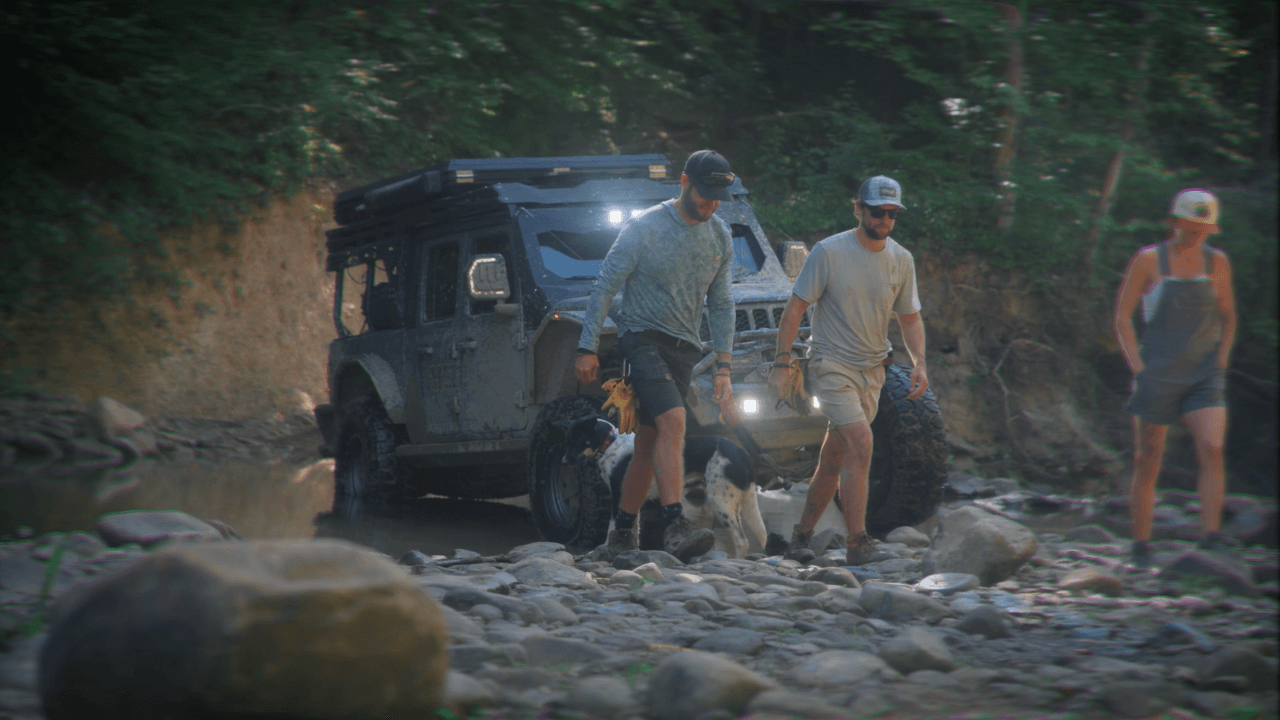
This episode follows Graham Ladd, Ethan Kaiser, Aleigha Elston, and MadLad’s trail dog Manny as they attempt the route entirely on their own, relying on training, communication, and recovery discipline.
Why Is the Atomic Trail So Challenging?
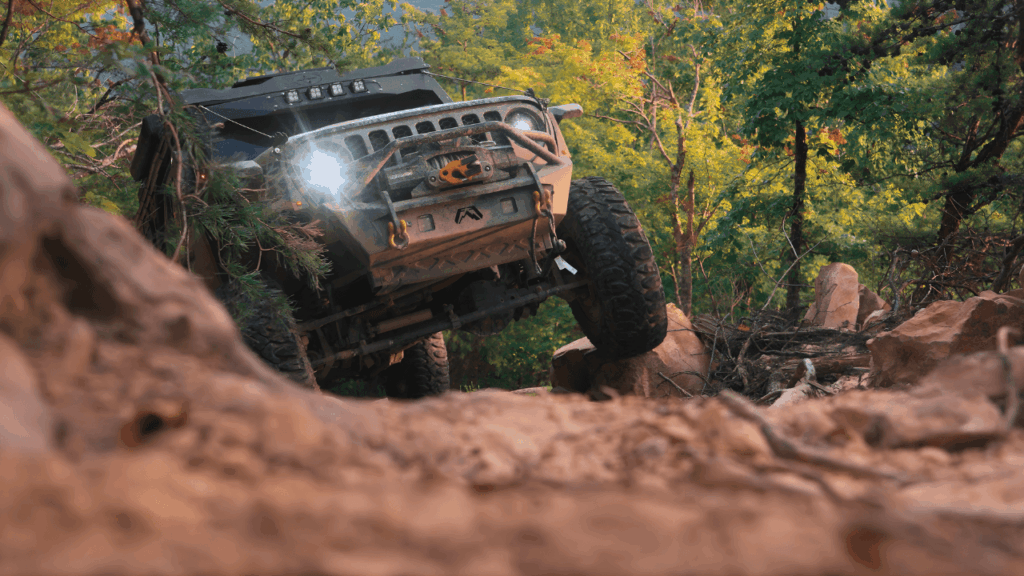
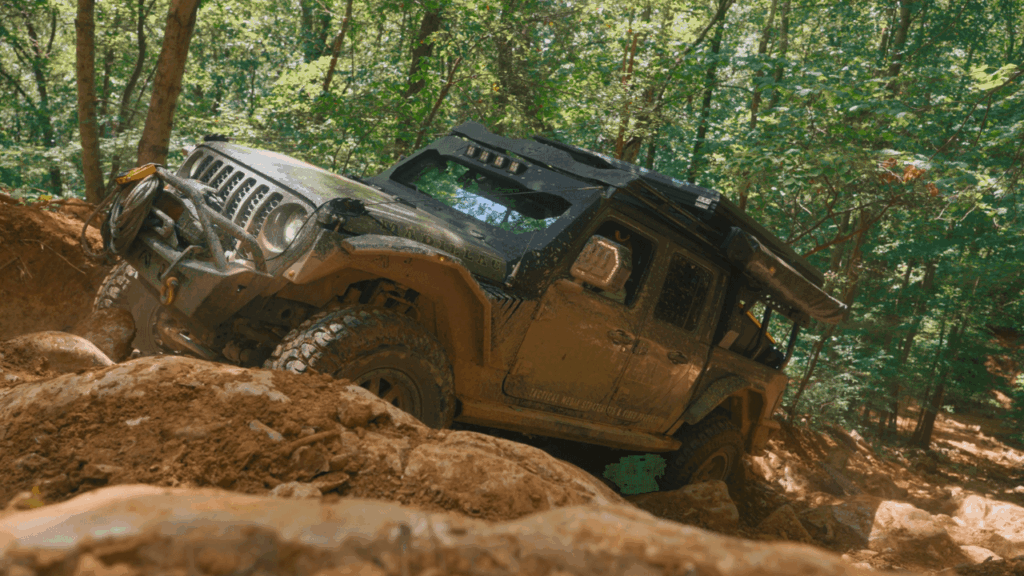
The Atomic Trail is not a casual overlanding route. It is a high-risk, high-consequence rock and mud trail that demands advanced driving skill and disciplined recovery techniques.
According to the episode itself, challenges include:
- Massive rock inclines where vehicles can only climb partway before traction disappears
- Multiple exposed rocky ledges where rigs travel inches from steep drop-offs, with real rollover risk
- Side-hill rock shelves that require careful spotting to avoid tipping toward the mountain edge
- Deep mud holes that dramatically increase resistance and vehicle load
- Long recovery sections requiring repeated winching, re-anchoring, and traction board placement
Notably, the MadLad crew tackles this trail without locking differentials, in a heavy rig on 37-inch tires, relying entirely on:
- Proper airing down (≈15 PSI)
- Controlled throttle
- Winch technique
- Traction boards
- Safe anchor selection
While locking differentials and 35-inch+ tires are strongly recommended for this terrain, this episode demonstrates how preparation and recovery knowledge can make the difference between progress and failure.
Nothing on this trail is staged.
Every obstacle is real.
Every mistake carries consequences.
Why This Location Matters
Long before off-road vehicles ever climbed these ridges, this terrain quietly supported one of the most consequential moments in modern history. Today, it offers a rare intersection of technical off-roading, industrial archaeology, and adventure storytelling.
This episode defines what MadLad Films and MadLadTV stand for—real challenges, real environments, and real education captured as it happens.
🎬 Watch the full episode on MadLadTV:
👉 https://madladfilms.com/portfolio/tennessees-lost-atomic-bomb-trail/
🚙 Our 2022 Jeep Gladiator Build – The “MADILLAC”
🛞 Tires, Wheels & Suspension
• Milestar Tires – https://bit.ly/milestar_tires
• Raceline Wheels – https://bit.ly/Raceline_Wheels
• Fabtech Suspension System – https://bit.ly/FabTech_Suspension
⚙ Under Carriage Upgrades
• Dana Spicer 5.38 Gears for Dana 44 Axles – https://bit.ly/Dana_Spicer
• Victor-Lock Differential Gasket – https://bit.ly/Dana_Spicer
🚙 Armor & Exterior Upgrades
• Fab Fours Overland Rack, Extensions, Light Inserts – https://bit.ly/fabfoursoverlandrack
• Fab Fours Front & Rear Bumpers, Vicowl, Fenders, Limb Risers – https://bit.ly/fabfoursvicowl
• Rock Slide Engineering – Rock Sliders – https://bit.ly/Rock_Sliders
• Boost Auto Trail Mirrors – https://bit.ly/boostauto_tm
• Rigid Industries Lights – https://bit.ly/rigidindustries
⚙ Recovery & Accessories
• WARN Zeon 10-S Winch – https://bit.ly/WARN_Winches
• Factor 55 Recovery Kit – https://bit.ly/F55_RK
• Rugged Radios – https://bit.ly/Rugged_Radios
⛺ Overlanding Gear
• ROAM Adventure Co. Rugged Cases – https://bit.ly/RoamAdvCo
• Overland Pros Awnings & Baja Wedge Tent – https://bit.ly/OverlandPros
• Portable Generators – Flex Power – RVMP – https://bit.ly/RVMP_PG
🎬 Episode Crew
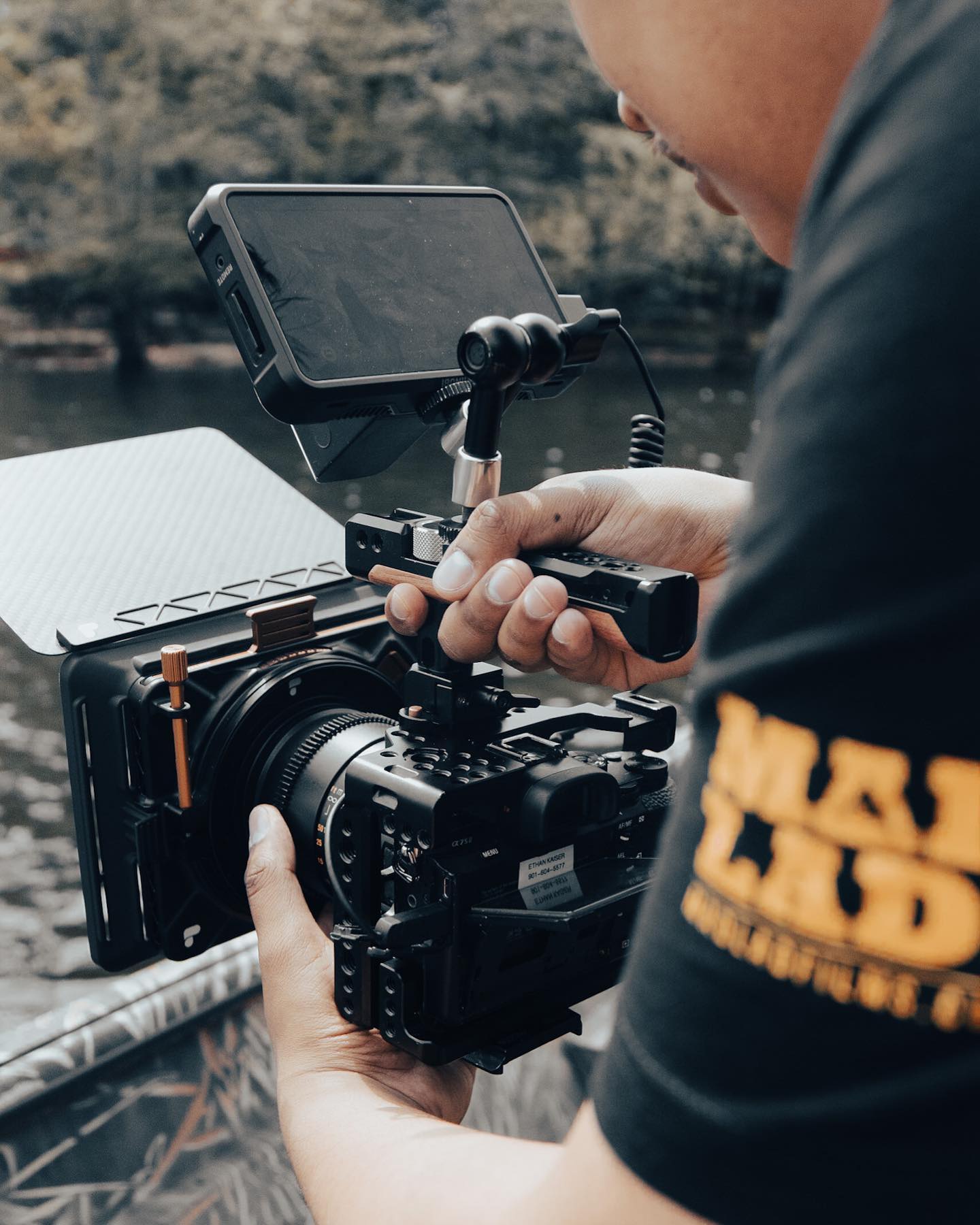
🎥 Produced, Filmed & Edited by MadLad Films
MadLad Films Instagram – https://bit.ly/MLFinstagram
Website – https://bit.ly/MadLadFilms
#MadLadFilms #MadLadTV #JeepGladiator #AdventureJeep #Overlanding #JeepLife #4×4 #OffRoad #OverlandBuild #JeepMods #TrailRig #GladiatorBuild #JeepNation #BFGoodrich #RacelineWheels #FabtechSuspension #DanaSpicer #FabFours #RockSlideEngineering #BoostAuto #WARN #Factor55 #RuggedRadios #ROAMAdventureCo #OverlandPros #RVMP